The Legend of Chef Amazing
and why there is always one
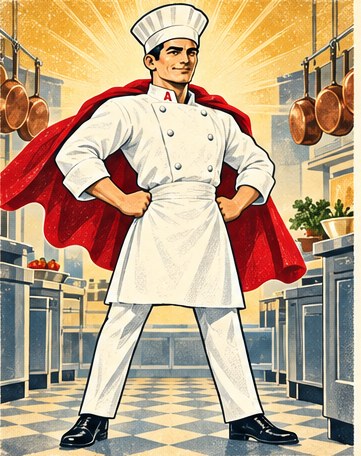
Every village had one. Every street with a corner shop, every building with a stairwell, every family with more mouths than money. Somebody who knew what to do with what was left.
Not a chef. A person. The one you went to at five o’clock holding half a cabbage and an egg, who looked at it, thought for exactly one second, and told you.
Nobody wrote any of it down. It moved hand to hand, kitchen to kitchen, by standing next to someone while they did it. That is the legend. Not a man in a cape — a line, passed along, unbroken for about as long as there have been people and fire.
And then, quietly, the line began to thin.
People moved three hundred miles from their mothers. The kitchen got smaller and the hours got longer, and the person you would have asked was no longer downstairs. Ten thousand years of knowing went into books, and out of books into screens, and somewhere in there the handing stopped.
You could find nine hundred recipes in four seconds. There was nobody to ask.
One person noticed.
The umbrella factory, 1948
Amanda Zing was not much of a cook and never pretended otherwise. In forty years she made two things, both of them extremely well, and both still turn up on his list when somebody says they have nothing in: anchovy butter on toast, and a potato and onion tortilla. “Two saucepans,” she said. “Two dishes. I saw no reason to expand.”
What she could do was see a problem before it had a name. In 1948, in a former umbrella factory with one desk, two saucepans and a telephone that only accepted incoming calls, she looked at the modern evening and saw what everyone else had missed. They saw a market for cookbooks. She saw a line about to go out.
So she found a cook. He was gifted, chronically overenthusiastic, and had a legal name that has long since been misplaced. She named him Chef Amazing — “it was more encouraging than what I had been calling him” — and she gave him the only job the Corporation has ever had. The brief fit on a card. It still does.
Keep it going.
Answer the question.
Every time it is asked.
How he worked
He never once asked what you wanted for dinner. He thought it was a cruel question, and he was right. He asked what you had.
Then he asked who was at the table, and he wrote that down, and he never asked it again. He kept a card on every house that ever called: who was off meat, who was nine, whose mother-in-law came on Sundays, which oven ran hot on the left. By 1952 the cards filled a room. By 1958 they filled the factory floor, and Amanda had the umbrella racks taken out to make space.
He decided before you called. That was the trick nobody could copy. By the time the telephone rang at twenty to seven he had already looked at your card, your weather and your week, and the answer was waiting. What people took for genius was mostly the fact that he had done the thinking in the morning.
He had rules, and he did not call them rules.
A meal is a main and a side, and the safe one and the new one need not be the same dish. Meatloaf on a Tuesday was his excuse to put something next to it you had never eaten. “The loaf won’t mind,” he’d say. It was on the side of the plate that whole households learned to eat.
He asked why, but only once, and only after you said no. “Not the fish tonight.” “Fair enough — what’s it about?” And whatever you answered went on the card, next to what you actually cooked, because he had noticed early that what people say they like and what they choose at six o’clock are two different facts, and that a good cook serves the second while honouring the first.
He wanted to see the plate afterward. Not a review — he had no patience for reviews. The plate told him what had happened: whether it had rested, whether the salad went first, which child had picked the olives out. He read plates the way other men read faces, and next week’s answer was written from what he saw.
And he never wrote anything in your name that you had not seen. That one was Amanda’s. “He drafts,” she said. “You send. That’s the whole of the arrangement.”
The night everyone tells you about
February 1954. Roads closed, the switchboard lit at four in the afternoon, and him at it until breakfast.
Cabbage and a tin of anchovies. Half a chicken and no onions. A woman upstate with nine guests, three pounds of potatoes and a husband she described as no help whatsoever. Four thousand dinners out of what those four thousand houses already had, and not one of them told to go to the store, because there was no store to go to.
The evening paper ran it two days later under a headline the Corporation has never been able to shake.
THE “WHAT’S FOR DINNER” SUPER-HERO
Amanda thought it was ridiculous. She had it framed anyway. It hangs in the factory still, slightly crooked, because she hung it herself.
But the blizzard is not the legend. The blizzard is only the night the legend was tested.
The legend is the ordinary Tuesday.
Somebody at twenty to seven with a tired head and an odd fridge, and somebody else who says here’s what we’re having, and dinner happening. That is all it has ever been. It survived plague and rationing and the invention of the freezer. It has had a harder time with the modern evening than with any of those.
Amanda goes out
Somewhere in the sixties, Amanda stopped coming to the factory and started sending postcards.
She had realised that the question had a second half. What’s for dinner is sometimes answered by we’re going out, and nobody was holding that line either. So she went and held it herself — every city, every back room, every place with a chef worth befriending, which turned out to be most of them. She ate at a rate that alarmed her doctor and kept a notebook that alarmed the restaurants.
She never gave a score. She gave you one place, with the reason, and she knew whether it was the two of you or the whole table, whether you were looking to impress or to hide. She wrote ahead, in whatever language the kitchen spoke, to say who was coming and what mattered. She remembered your birthday in May so that the table existed in June.
The cooks she befriended started calling the notebook the blend, because it held their word and the critics’ word and the word of everyone who had actually eaten there, and somehow came out fair. The name stuck. She hated it less than the headline.
She still writes. You will press send.
The name passes
Here is the part the papers never understood.
Chef Amazing is not a man. It is a post, like a lighthouse keeper’s. The first one trained the second by the only method he trusted — standing next to him for eleven years — and the second trained the third, and the cards were handed over each time, every house intact, every oven’s habits remembered.
There has always been one. There is one now. The legal name is, as ever, misplaced, and the brief on the card has not changed a word since 1948.
This is the tribute
This app is the current keeper.
Everything it does, he did first, by telephone, for a house at a time. It looks in your fridge because the person who used to look in it does not live nearby any more. It decides in the morning because he did. It puts the new thing on the side of the plate, asks why only after you say no, reads the plate afterward, and never sends a word in your name unseen. It keeps a card on your house — who is off meat, who is nine, which burner runs hot — and it never asks twice.
It is not a recipe service. There is no shortage of recipes. It is a line, held open, by the one person whose job that is, at the exact moment the line was about to go out.
He has never rescued anyone from a burning building and would like that understood. What he rescues is twenty to seven on a Tuesday, which has been the hard part all along.
Here is the part that concerns you
A legend is not kept by the one who tells it. It is kept by the people who hear it and tell it again.
Every dinner you cook is a link back in. Every plate he reads is a link forward. The children at your table are learning what a house tastes like, the way everybody always learned, and one day somebody will ask them what to do with half a cabbage and an egg — and either they will know, or the line stops with you. No pressure.
FROM THE FILES — EVERY ONE OF THESE IS A REAL DINNER
OR GO STRAIGHT AT IT
So: what’s for dinner?
Amanda Zing and the umbrella factory · The Test Kitchen · Everything he can do
Chef Amazing remembers every place you ate, keeps the lists friends send you, and helps you cook it at home.
Our founder's story · For chefs and food creators · Privacy · Terms