‹ The best bowl in 50 cities › New York City
Soup season · New York City, United States
The best bowl in New York City: Borscht

Ukrainian beet soup with beef, cabbage and dill, deep red and sweet-sour, with sour cream and a slice of challah.
New York has a thousand soups, but the one that's been feeding the East Village since 1954, and became a symbol of the city's Ukrainians in 2022, is the borscht at Veselka.
Veselka
144 2nd Ave, New York, NY 10003
Get: A bowl of the Ukrainian borscht with challah, and a plate of half boiled, half fried pierogi
A bowl of borscht with challah, and pierogi half boiled, half fried.
Open since 1954 on the corner of 9th Street, run by the third generation of the same family. The borscht is the classic, made with beef and loads of dill.
Open late every day; mornings are quietest.
Make it at home
Ukrainian borscht with beef and dill
Real borscht is a full meal: beef broth, beets, cabbage, potato and beans, balanced with a little vinegar and sugar. The trick is cooking the beets separately with acid so they stay ruby red.
You need
- 1 1/2 lb (700 g) bone-in beef shank or short ribs
- 3 quarts (2.8 l) water
- 1 bay leaf and 6 black peppercorns
- 2 tsp kosher salt, plus more to taste
- 3 medium beets (about 1 1/4 lb / 570 g), peeled and cut in matchsticks
- 2 tbsp red wine vinegar
- 1 tbsp sugar
- 3 tbsp sunflower or neutral oil
- 1 onion, chopped
- 1 carrot, grated
- 2 tbsp tomato paste
- 2 medium potatoes, peeled and diced
- 1/2 small head green cabbage, thinly sliced
- 1 can (15 oz) white beans, drained (optional)
- 4 cloves garlic, crushed with a pinch of salt
- 1 large bunch dill, chopped
- To serve: sour cream and rye bread or challah
How to make it
- Put the beef in a large pot with the water, bay leaf, peppercorns and salt. Bring to a boil, skim, then simmer gently 1 1/2 hours until the meat is tender.
- Meanwhile, heat the oil in a large skillet over medium heat. Cook the onion and carrot 8 minutes until soft. Add the beets, vinegar, sugar and tomato paste with 1/2 cup of the beef broth. Cover and cook 20 minutes, stirring now and then, until the beets are tender. This keeps them red.
- Lift out the beef, pull the meat from the bones in bite-size pieces and return it to the pot. Strain out the bay and peppercorns if you like.
- Add the potatoes to the broth and simmer 10 minutes. Add the cabbage and simmer 10 more.
- Stir in the beet mixture and the beans. Bring back just to a simmer (don't boil hard, or the color fades).
- Stir in the garlic and half the dill. Taste: it should be gently sweet-sour. Add salt, a pinch of sugar or a splash of vinegar to get there.
- Turn off the heat, cover and rest 20 minutes. Serve with a spoonful of sour cream, more dill and bread.
Pans and tools
- 8-quart pot
- large skillet
- box grater
Chef's tips
- Wear gloves for the beets, or rub your hands with lemon after.
- Borscht is better on day two and keeps 5 days in the fridge.
- For a meatless version, use vegetable stock and add a few dried mushrooms.
Four more bowls in New York City
Matzo ball soup
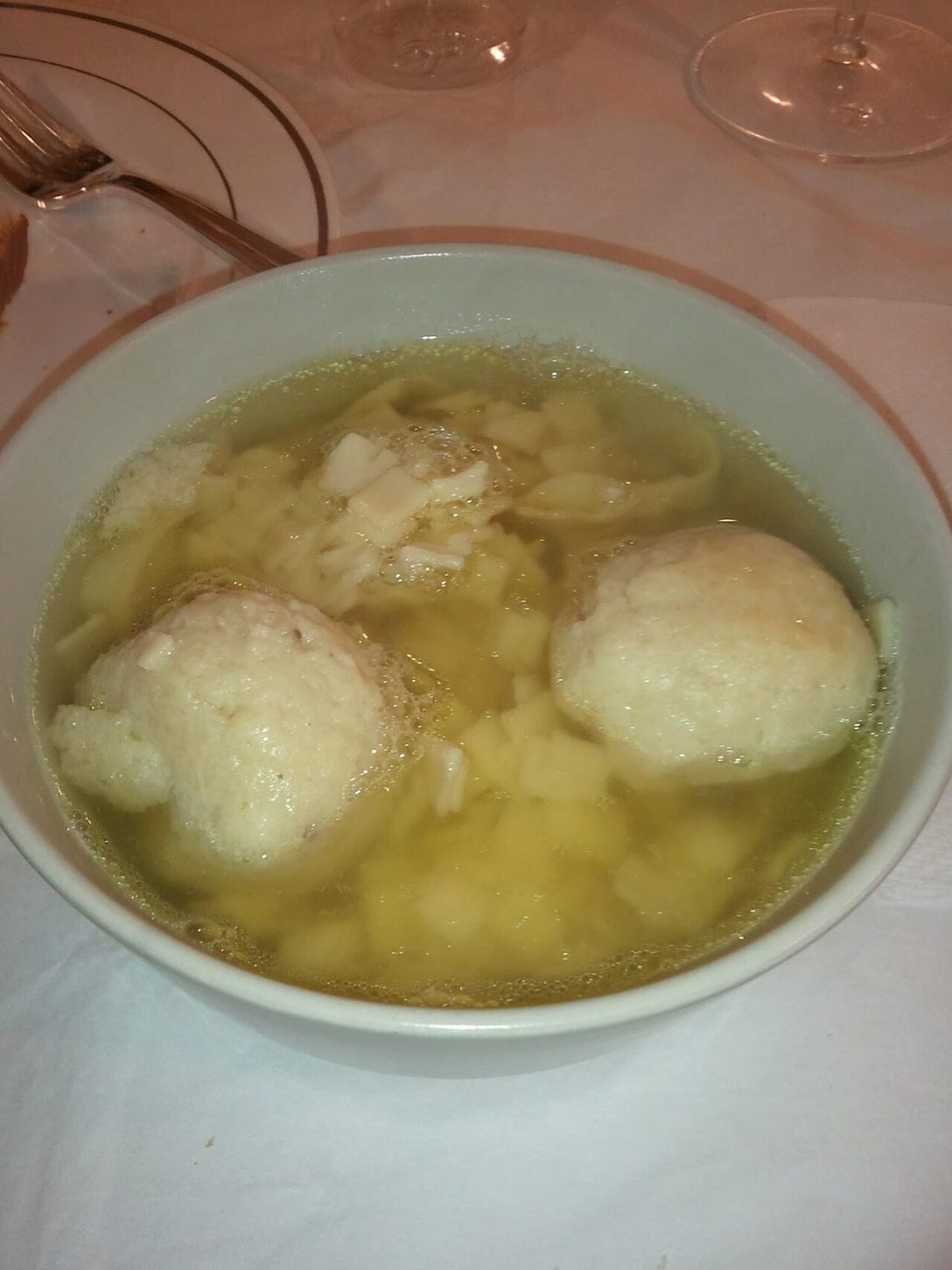
Chicken soup with one big matzo ball, at the Lower East Side's most famous deli.
Katz's Delicatessen · 205 E Houston St, New York, NY 10002
Get: Matzo ball soup and a pastrami on rye; keep your ticket
A matzo ball soup, please.
Open on this corner since 1888; hold onto the ticket they hand you at the door.
Make it at home: Matzo Ball Soup
Light, tender matzo balls in a clear chicken broth with carrots, celery and fresh dill. Inspired by the deli bowl, made in a home pot.
You need
- 1 cup (115 g) matzo meal
- 4 large eggs
- 5 tbsp schmaltz or neutral oil, divided (1/4 cup for the batter, 1 tbsp for the vegetables)
- 1/4 cup plain seltzer
- 1 1/2 tsp kosher salt, for the batter
- 1/4 tsp black pepper
- 1/4 cup chopped fresh dill, divided (2 tbsp in the batter, 2 tbsp for serving)
- 4 quarts water, for cooking the matzo balls
- 1 tbsp kosher salt, for the cooking water
- 8 cups low-sodium chicken broth
- 3 medium carrots (about 8 oz), peeled and sliced 1/4 inch thick
- 2 celery ribs, sliced 1/4 inch thick
- 1 small yellow onion (about 5 oz), finely diced
- Kosher salt, to taste
How to make it
- Whisk the eggs, 1/4 cup schmaltz, seltzer, 1 1/2 tsp salt, pepper and 2 tbsp dill in a large bowl until blended.
- Stir in the matzo meal until no dry spots remain. Cover and refrigerate for 30 minutes, until the batter is thick and scoopable.
- While it chills, heat the remaining 1 tbsp fat in the 4-quart pot over medium heat. Cook the onion, carrots and celery for 5 minutes, stirring, until the onion turns translucent.
- Add the broth to the vegetables and bring to a boil over high heat. Reduce to low, cover, and keep at a bare simmer for 15 minutes until the carrots are tender.
- Bring the 4 quarts of water and 1 tbsp salt to a boil in the 6-quart pot, then lower to a steady simmer.
- Wet your hands and roll the chilled batter into 12 balls, about 2 tbsp each. Do not pack them tightly, because they will roughly double in size.
- Slide the balls into the simmering water, cover, and cook for 30 minutes at a gentle simmer. Cut one open to check that it is pale and tender all the way through.
- Lift the matzo balls out with a slotted spoon and add them to the soup pot. Warm them in the broth over low heat for 5 minutes so they soak up flavor.
- Taste the broth and add kosher salt as needed. Ladle into bowls with 2 matzo balls each and sprinkle with the remaining 2 tbsp dill.
Pans and tools
- Large mixing bowl
- 6-quart pot with lid
- 4-quart soup pot
- Slotted spoon
- Small cookie scoop or tablespoon
Chef's tips
- Cook the balls in plain salted water, not the soup, or they cloud the broth and soak up its salt.
- Chill the batter and keep the simmer gentle, since a hard boil breaks the balls apart.
- Make the balls up to 2 days ahead and store in broth in the fridge. Reheat gently in the soup.
- For firmer balls, swap the seltzer for broth; for fluffier ones, use very cold seltzer and do not overmix.
Shio ramen

A light shio ramen with rye noodles, from an American cook who made his name in Tokyo.
Ivan Ramen · 25 Clinton St, New York, NY 10002
Get: Tokyo shio ramen
The Tokyo shio, please.
Ivan Orkin ran a celebrated ramen shop in Tokyo before bringing it home to New York.
Make it at home: Shio ramen with chashu and soft egg
A home-scale version of a Hokkaido-style pork shio. The broth simmers hard so the bones turn it milky; the seasoning is just salt, kombu and a little dashi, so the broth has to be good. Make the eggs and chashu the day before.
You need
- For the broth: 3 lb (1.4 kg) pork neck bones or trotters, 2 lb (900 g) chicken backs or wings, 4 quarts (3.8 l) water, 1 onion, 2-inch piece ginger, 6 garlic cloves, 3 scallions
- For the chashu: 1 1/2 lb (700 g) pork belly, skin off, rolled and tied; 1/2 cup soy sauce, 1/2 cup mirin, 1/4 cup sake, 2 tbsp sugar, 1 cup water
- For the eggs: 4 eggs, plus 1/4 cup of the chashu liquid and 1/4 cup water
- For the shio tare: 1 piece kombu (4 inches), 1 cup water, 2 tbsp sake, 1 tbsp mirin, 2 1/2 tbsp sea salt, 1 tsp dashi powder or a handful of bonito flakes
- For the aroma oil: 1/4 cup pork or chicken fat (skimmed from the broth), 2 scallions, 1 garlic clove
- 4 portions (about 1 lb / 450 g) fresh thin wavy ramen noodles
- To top: menma (bamboo shoots), sliced scallion, 4 umeboshi (pickled plums), nori sheets
How to make it
- Broth: blanch the pork bones and chicken in boiling water 10 minutes, drain and rinse off the scum. Return to a clean pot with 4 quarts fresh water. Boil hard, uncovered, 4 hours, topping up with water to keep the bones covered, until the broth is milky. Add the onion, ginger, garlic and scallions for the last hour. Strain; you want about 2 quarts.
- Chashu (the day before): brown the rolled pork belly on all sides in a pot, add the soy, mirin, sake, sugar and water, cover and simmer on low 2 hours, turning every 30 minutes. Cool in the liquid and refrigerate.
- Eggs (the day before): boil the eggs 6 1/2 minutes, chill in ice water and peel. Soak overnight in the chashu liquid mixed with water.
- Tare: soak the kombu in the water 30 minutes, then bring just to a simmer and remove the kombu. Add the sake, mirin, salt and dashi, stir until the salt dissolves, and strain.
- Aroma oil: warm the fat with the scallions and garlic over low heat 10 minutes until fragrant. Strain.
- To serve, slice the chashu and warm it in a little broth. Bring the broth to a simmer. Put 3 tbsp tare and 1 tbsp aroma oil in each warm bowl.
- Boil the noodles in a big pot of unsalted water for the time on the packet (usually 60-90 seconds), shake dry, and put in the bowls. Pour 1 1/2 cups hot broth over each. Top with chashu, a halved egg, menma, scallions, an umeboshi and nori.
Pans and tools
- 12-quart stockpot
- medium pot for the chashu
- fine sieve
- large pot for the noodles
- kitchen twine
Chef's tips
- Taste one bowl first: if it's flat, add tare a teaspoon at a time.
- The broth freezes well in 1 1/2-cup portions for ramen night.
- Warm the bowls with hot water; ramen cools fast.
Wonton noodle soup

Shrimp wontons and thin egg noodles in a clear broth, in Chinatown.
Great NY Noodletown · 28 Bowery, New York, NY 10013
Get: Shrimp wonton noodle soup, and roast pork on the side
Shrimp wonton noodle soup, please.
A Bowery Cantonese canteen open late, where chefs go after their shifts.
Cash only.
Make it at home: Hong Kong shrimp wonton noodle soup
Dried flounder and dried shrimp give the broth its deep, sweet sea flavor. Toast the flounder before simmering. Fill the wontons with mostly shrimp and a little pork fat so they snap when you bite.
You need
- For the broth: 1 oz (30 g) dried flounder (daimyo fish), 2 tbsp dried shrimp, 2 lb (900 g) pork bones, 1 small piece rock sugar or 1 tsp sugar, 10 cups (2.4 l) water, 1 tsp salt, white pepper
- For the wontons: 10 oz (280 g) raw shrimp, peeled, deveined and patted dry
- 2 oz (55 g) fatty ground pork
- 1 tsp salt, 1 tsp sugar, 1/2 tsp sesame oil, 1/4 tsp white pepper, 1 tsp cornstarch, 1 egg yolk
- About 32 thin square wonton wrappers (the yellow Hong Kong style)
- 4 portions (about 10 oz / 280 g) thin fresh egg noodles (wonton noodles)
- To serve: chopped yellow chives or scallions, a few drops of sesame oil, red vinegar and chili oil on the side
How to make it
- Toast the dried flounder in a dry pan over medium-low heat, 2 to 3 minutes a side, until golden and fragrant. Break into pieces.
- Put the pork bones in a pot of cold water, bring to a boil for 5 minutes, drain and rinse. This keeps the broth clear.
- Return the bones to the clean pot with the toasted flounder, dried shrimp, rock sugar and the 10 cups water. Bring to a boil, then simmer very gently, uncovered, for 1 hour. Never let it boil hard or it clouds. Strain, season with salt and white pepper.
- For the wontons, cut each shrimp into 3 pieces, and lightly smash half of them with the flat of a cleaver. Mix with the pork, salt, sugar, sesame oil, pepper, cornstarch and yolk. Stir hard in one direction for 2 minutes until sticky. Chill 15 minutes.
- Put a heaped teaspoon of filling in the center of a wrapper. Wet the edges, fold in half into a triangle, press out the air, then bring the two side corners together and pinch. Keep them under a damp towel.
- Bring two pots of water to a boil. Boil the wontons in one for 3 to 4 minutes, until they float and the shrimp shows pink through the wrapper.
- Shake the noodles loose and cook them in the other pot for 20 to 30 seconds only. Lift them out and rinse quickly under cold water, then dip back in the hot water 5 seconds. This gives the springy bite.
- Put 8 wontons in each bowl, the noodles on top, then ladle over the hot broth. Finish with chives and a drop of sesame oil. Serve with red vinegar and chili oil.
Pans and tools
- Stockpot
- Two pots for boiling
- Fine-mesh strainer
- Spider or slotted spoon
Chef's tips
- Dried flounder is sold in Chinese grocers; the broth is still good without it, using more dried shrimp.
- Freeze extra wontons on a tray, then bag them. Cook from frozen, adding a minute.
- Hong Kong noodles are alkaline, thin and yellow; look for fresh wonton noodles in the refrigerated aisle.
Ox bone soup

Milky-white beef bone broth, salted at the table, with rice and kimchi.
Gammeeok · 25 W 32nd St, New York, NY 10001
Get: Seolleongtang and the bossam
Seolleongtang, please.Ox bone soup, please.
A Koreatown specialist in ox bone soup.
Make it at home: Seolleongtang (milky ox bone soup)
There's no seasoning in the pot: just bones, water and time. The broth turns milky-white from a hard, long boil. Everyone seasons their own bowl with salt, pepper and scallions at the table.
You need
- 4 lb (1.8 kg) beef leg bones (sagol) or knuckle bones, cut
- 1 lb (450 g) beef brisket or shank
- 6 quarts (5.7 l) water, plus more to top up
- 1 onion, halved
- 1 head garlic
- 1 2-inch piece ginger
- 8 oz (225 g) thin Korean starch noodles (somyeon or dangmyeon)
- To serve: sea salt, black pepper, 4 scallions finely sliced, steamed rice, kkakdugi (radish kimchi) and napa cabbage kimchi
How to make it
- Soak the bones in cold water 2 hours, changing the water once, to draw out the blood.
- Put the bones in a big pot, cover with water, boil 10 minutes, drain and rinse the bones and the pot.
- Return the bones to the pot with 6 quarts fresh water. Bring to a rolling boil and keep it boiling hard, partly covered, for 4 hours. Add the brisket, onion, garlic and ginger after the first hour; lift out the brisket after 1 1/2 hours, when tender, and refrigerate it.
- Top up with boiling water every hour to keep the bones covered. After 4 hours the broth will be milky. Pour it off into another pot.
- Add 4 quarts fresh water to the bones and boil hard 4 more hours. Combine the two batches (this makes the broth whiter and richer). Strain and chill; lift off the fat when it sets.
- Cook the noodles as the packet says, drain and rinse. Slice the brisket thinly.
- Bring the broth to a boil. Put noodles and brisket in each bowl and ladle the boiling broth over. At the table, everyone adds salt, pepper and a big spoonful of scallions, and eats it with rice and kimchi.
Pans and tools
- 16-quart stockpot
- fine sieve
- large container for chilling
Chef's tips
- It must boil hard, not simmer, or the broth stays clear.
- Make a big batch: it freezes for 3 months.
- Add rice straight into the broth for the way Seoul eats it at breakfast.
Is this your restaurant?
You make the best bowl in New York City, by our read. Make your card above (it downloads, or opens your share sheet on a phone), post it, and tag us. Here's your tag for your site:

<a href="https://www.chefamazing.com/soup/new-york-city"><img src="https://www.chefamazing.com/soup/badge/new-york-city.svg" alt="Veselka: the best bowl in New York City" height="46"></a>
Something changed? Write to hello@chefamazing.com.Bowls nearby

All 50 bowls The 25 best soup recipes
No. 1 checked October 28, 2026; the other four picked the same day from local guides and menus. Places change; if one has, tell us at hello@chefamazing.com.
Chef Amazing remembers every place you ate, keeps the lists friends send you, and helps you cook it at home.
Our founder's story · For chefs and food creators · Privacy · Terms