‹ The best bowl in 50 cities › Miami
Soup season · Miami, United States
The best bowl in Miami: Haitian squash soup

Pumpkin soup with beef, pasta, cabbage, potatoes and Scotch bonnet, the soup of Haitian independence.
Haitians eat soup joumou on Sunday mornings and every January 1, the anniversary of independence (UNESCO lists it as world heritage). In North Miami, L'Auberge sells out of it before noon.
L'Auberge
13315 W Dixie Hwy, North Miami, FL 33161
Get: A large soup joumou to eat there, and a quart to take home
Bonjou, ban m yon gwo soup joumou, souple.Hello, a large pumpkin soup, please (in Haitian Creole).
A small Haitian restaurant that makes joumou the way families do on Sunday, with beef on the bone and a squash broth you could stand a spoon in. Cash only.
Sunday mornings; it usually sells out before noon.
Make it at home
Soup joumou (Haitian pumpkin soup with beef)
The beef marinates in epis (a green seasoning of herbs, peppers and garlic) and citrus, then the squash cooks down into a velvety base. A whole Scotch bonnet floats in the pot for its perfume; don't let it burst unless you want heat.
You need
- 2 lb (900 g) beef shank or chuck, in 2-inch pieces, bone in if possible
- Juice of 2 limes and 1 orange (or 1/2 cup sour orange juice)
- 1/2 cup (120 ml) epis: blend 1 green pepper, 6 scallions, 1 cup parsley, 6 garlic cloves, 4 thyme sprigs and 1/4 cup oil until smooth
- 1 tbsp kosher salt, plus more to taste
- 1 calabaza or kabocha squash (about 3 lb / 1.4 kg), peeled, seeded and cubed
- 3 quarts (2.8 l) water
- 2 carrots, sliced
- 2 medium potatoes, peeled and cubed
- 1 small turnip, peeled and cubed
- 1/4 head green cabbage, sliced
- 1 leek, sliced
- 1 celery stalk, sliced
- 1 whole Scotch bonnet pepper
- 6 whole cloves stuck into 1 small onion
- 4 oz (115 g) rigatoni or spaghetti broken in pieces
- 2 tbsp butter
- Fresh thyme and parsley
How to make it
- The night before, toss the beef with the citrus juice, epis and 1 tsp of the salt. Refrigerate overnight.
- Put the beef and its marinade in a large pot with 1 cup water. Cover and cook over medium heat 45 minutes, stirring now and then, until the meat has released its juice and is starting to soften.
- Meanwhile, cook the squash in 2 quarts of the water until very soft, 25 minutes. Blend the squash and its water until smooth.
- Pour the squash purée and the rest of the water over the beef. Add the clove-studded onion, the whole Scotch bonnet, the thyme and parsley and the remaining salt. Simmer 1 hour, stirring from the bottom.
- Add the carrots, potatoes, turnip, cabbage, leek and celery. Simmer 30 minutes until the vegetables are tender.
- Add the pasta and cook 12 minutes. Stir in the butter. Taste for salt. Fish out the onion and the pepper (carefully, so it doesn't burst).
- Serve hot in deep bowls with bread.
Pans and tools
- 8-quart heavy pot
- blender
- saucepan
Chef's tips
- Butternut works if you can't find calabaza; it's a little sweeter.
- For heat, prick the Scotch bonnet once with a knife before it goes in.
- Pasta keeps drinking broth: add water when you reheat.
Four more bowls in Miami
Black bean soup
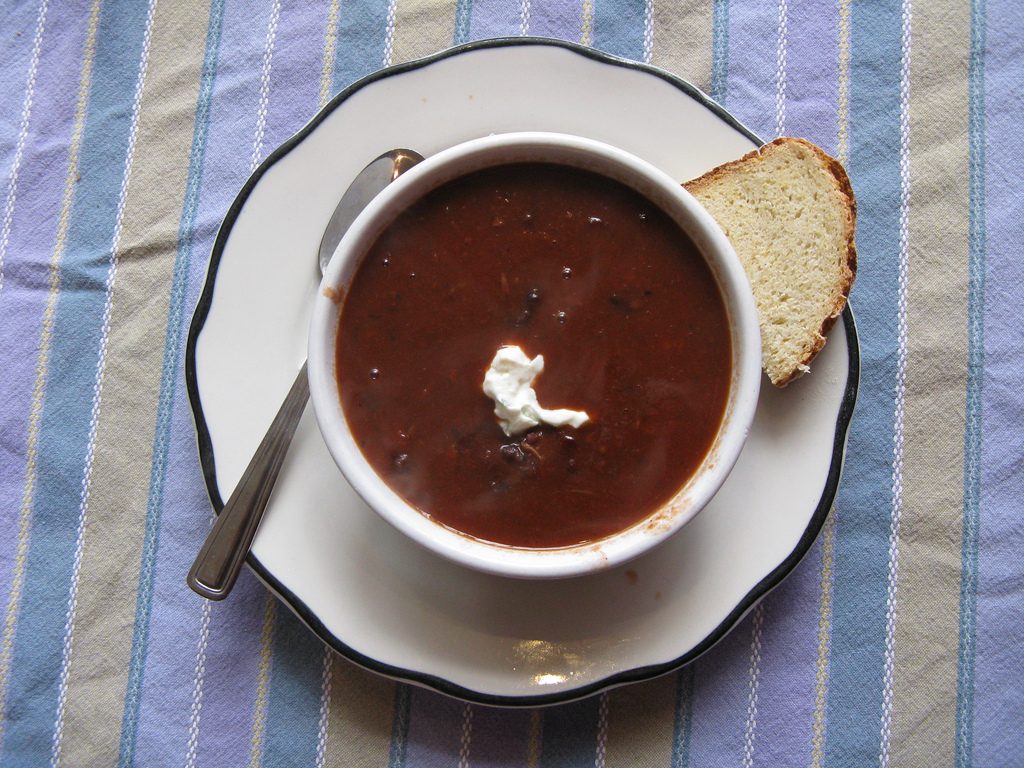
Cuban black bean soup with rice and chopped onion, on Calle Ocho.
Versailles · 3555 SW 8th St, Miami, FL 33135
Get: Black bean soup, a Cuban sandwich, and a cafecito at the window
Una sopa de frijoles negros, por favor.A black bean soup, please.
The Cuban restaurant of Miami since 1971, where the exile community meets over coffee.
Make it at home: Black Bean Soup
A thick, savory Cuban-style black bean soup built on a slow-cooked sofrito of onion, green pepper and garlic, finished with a splash of vinegar. Serve it over fluffy white rice. Inspired by the black beans at Versailles in Miami.
You need
- 1 lb (454 g, about 2 1/4 cups) dried black beans, picked over and rinsed
- 10 cups water, divided (6 cups for soaking, 8 cups for cooking, minus a little to top up as needed)
- 2 bay leaves
- 1/4 cup (60 ml) extra-virgin olive oil
- 1 large yellow onion (about 10 oz), finely diced (about 1 1/2 cups)
- 1 large green bell pepper (about 8 oz), seeded and finely diced (about 1 1/4 cups)
- 6 garlic cloves, minced (about 2 tablespoons)
- 2 teaspoons ground cumin
- 2 teaspoons dried oregano
- 1/2 teaspoon freshly ground black pepper
- 2 teaspoons kosher salt, plus more to taste
- 2 tablespoons red wine vinegar
- 1 1/2 cups (300 g) long-grain white rice
- 3 cups water for the rice
- 1/2 teaspoon kosher salt for the rice
- 1/2 cup finely diced raw white onion for garnish
- 2 tablespoons extra-virgin olive oil for drizzling
How to make it
- Put the beans in the Dutch oven with 6 cups of the water and soak for 8 hours or overnight on the counter. They will swell to about double their size.
- Drain the soaked beans and return them to the pot with 8 cups fresh water and the bay leaves. Bring to a boil over high heat, about 10 minutes, then skim off any foam.
- Reduce the heat so the beans barely bubble, partly cover the pot, and simmer for 1 hour 15 minutes. Add a splash of hot water if the beans are no longer covered by 1 inch of liquid.
- While the beans simmer, heat the 1/4 cup olive oil in the skillet over medium heat. Add the diced onion and green pepper and cook for 10 to 12 minutes, stirring often, until very soft and the onion is translucent but not browned.
- Stir the garlic, cumin, oregano and black pepper into the skillet and cook for 1 minute, until fragrant. Scrape this sofrito into the pot of beans, rinsing the skillet with 1/4 cup of the bean liquid and pouring that in too.
- Add the 2 teaspoons salt to the pot and stir. Simmer, partly covered, for 45 minutes more, stirring now and then, until the beans are completely creamy-tender when pressed between your fingers.
- Meanwhile, rinse the rice in a colander until the water runs mostly clear. Combine it in the saucepan with the 3 cups water and 1/2 teaspoon salt and bring to a boil over high heat.
- Cover the rice, turn the heat to the lowest setting, and cook for 18 minutes without lifting the lid. Remove from the heat and let it stand covered for 5 minutes, then fluff with a fork.
- Fish out the bay leaves. Mash about 1 cup of the beans against the side of the pot with a potato masher, or pulse a few times with an immersion blender, until the soup thickens to a spoonable stew.
- Simmer the thickened soup uncovered for 10 minutes, stirring, until it coats the back of a spoon. Stir in the vinegar and taste, adding more salt until the flavor is bright and round.
- Let the pot rest off the heat for 10 minutes so the flavors settle. Spoon rice into bowls, ladle the soup on top, and finish with the raw onion and a drizzle of olive oil.
Pans and tools
- 6-quart Dutch oven or heavy pot with lid
- 12-inch skillet
- medium saucepan with lid
- colander
- potato masher or immersion blender
Chef's tips
- Common mistake: skipping the soak and cooking at a hard boil, which splits skins and leaves the centers firm. Keep it at a gentle simmer.
- The soup always tastes better the next day. Refrigerate up to 5 days and thin with water when reheating over low heat.
- Freeze in portions for up to 3 months, without the rice.
- Swap: use a quick soak by boiling the beans for 2 minutes, then standing covered for 1 hour, before draining.
Pho

A careful, homestyle pho on Calle Ocho, from a Vietnamese kitchen Miami has loved for decades.
Hy Vong · 3458 SW 8th St, Miami, FL 33135
Get: Pho, and the spring rolls
Pho, please.
Opened in 1980 and now on the Michelin Bib Gourmand list for Miami.
Make it at home: Pho Bo
A clear, fragrant beef broth simmered for hours with charred onion, ginger and warm spices, poured over rice noodles and paper-thin raw beef. Inspired by the beef noodle soup at Le Colonial in Houston.
You need
- 2 lb (900 g) beef oxtail, cut in sections
- 2 lb (900 g) beef marrow or knuckle bones
- 2 medium yellow onions (about 1 lb), halved and left unpeeled
- 4-inch piece fresh ginger (about 3 oz), halved lengthwise
- 3 whole star anise
- 1 cinnamon stick (3 inches)
- 4 whole cloves
- 1 teaspoon coriander seeds
- 1 teaspoon fennel seeds
- 5 quarts (4.7 liters) cold water, plus more for parboiling
- 3 tablespoons fish sauce, plus more to taste
- 1 tablespoon kosher salt
- 1 tablespoon sugar
- 1 lb (450 g) dried flat rice noodles (banh pho)
- 8 oz (225 g) beef tenderloin, trimmed and sliced paper thin
- 1 small white onion, very thinly sliced
- 2 scallions, thinly sliced
- 2 cups bean sprouts
- 1 cup Thai basil leaves
- 1/2 cup cilantro sprigs
- 1 jalapeno, thinly sliced
- 3 limes, cut into wedges
- Hoisin sauce and sriracha for the table (3 tablespoons each)
How to make it
- Put the oxtail and bones in the stockpot, cover with cold water by 2 inches, and bring to a boil over high heat. Boil hard for 10 minutes while gray scum rises, then drain and rinse every piece under cold water. Scrub out the pot.
- Heat the broiler with a rack 4 inches from the element. Broil the onion halves and ginger on the baking sheet for 10 minutes, turning once, until blackened in spots and soft. Cool, peel off the loose skin, and rinse.
- Toast the star anise, cinnamon, cloves, coriander and fennel in the dry skillet over medium heat for 2 minutes, until fragrant. Tie them into cheesecloth.
- Return the bones to the clean pot with the 5 quarts cold water, charred onion, ginger and the spice bundle. Bring to a boil over high heat, about 20 minutes, skimming off foam.
- Reduce the heat to low so the surface barely trembles. Simmer partly covered for 3 hours, skimming now and then, and lift out the spice bundle after the first hour so it does not turn bitter.
- Lift the oxtail onto a plate. When cool enough to handle, pull the meat off the bones in large pieces and set aside, returning the bones to the pot.
- Strain the broth through the fine-mesh strainer into a clean pot, pressing lightly. Skim fat from the top with a ladle, then stir in the fish sauce, salt and sugar and taste, adding fish sauce until savory with a slight sweetness. Keep at a bare simmer.
- About 40 minutes before serving, wrap the beef tenderloin and freeze it for 20 minutes to firm it up. Soak the dried noodles in warm tap water for 30 minutes, until pliable and white.
- Slice the chilled beef against the grain as thin as paper. Arrange the sliced onion, scallions, sprouts, basil, cilantro, jalapeno and lime wedges on a platter.
- Boil a large pot of water and cook the soaked noodles for 1 to 2 minutes, until tender but still springy. Drain and divide among 6 large bowls, then lay the shredded oxtail and raw beef slices on top.
- Bring the broth to a rolling boil, then ladle at least 1 1/2 cups over each bowl; the heat cooks the raw beef to a blush pink within a minute. Serve with the garnish platter, hoisin and sriracha.
Pans and tools
- 12-quart stockpot
- rimmed baking sheet
- dry skillet
- fine-mesh strainer
- cheesecloth or tea ball for spices
- large pot for noodles
- sharp slicing knife
- instant-read thermometer
Chef's tips
- Common mistake: boiling the broth hard, which turns it cloudy. Keep it at a bare simmer and skim.
- Make-ahead: the broth keeps 5 days refrigerated or 3 months frozen. The fat that hardens on top is easy to lift off.
- Reheat the broth to a full boil before serving or the raw beef will not cook.
- Swap: use beef shank or short rib for part of the oxtail, and gluten-free tamari-free hoisin is optional at the table.
Cuban chicken soup

Chicken, noodles, potato and malanga in a broth with lime on the side, the soup Cuban grandmothers cure everything with.
La Carreta · 3632 SW 8th St, Miami, FL 33135
Get: Sopa de pollo with lime, and a croqueta
Una sopa de pollo, por favor.A chicken soup, please.
The Calle Ocho Cuban diner families have filled since 1976, open late.
Make it at home: Cuban sopa de pollo
A sofrito and a squeeze of lime set it apart from other chicken soups.
You need
- 2 1/2 lb (1.1 kg) chicken pieces, bone in
- 3 quarts (2.8 l) water
- 2 tbsp olive oil
- 1 onion, 1 green bell pepper and 4 garlic cloves, finely chopped
- 1/2 tsp cumin, 1 tsp dried oregano, 1 bay leaf
- 1 tomato, chopped
- 2 potatoes, cubed
- 1 malanga or yuca (about 1 lb / 450 g), peeled and cubed
- 2 carrots, sliced
- 1 ear of corn, in rounds
- 3 oz (85 g) fine egg noodles
- 2 tsp salt
- Limes and parsley, to serve
How to make it
- Simmer the chicken in the water with the bay leaf and salt 40 minutes, skimming. Lift out, shred and discard the bones.
- In the oil cook the onion, pepper and garlic 8 minutes, then the cumin, oregano and tomato 3 minutes.
- Add the sofrito, potatoes, malanga, carrots and corn to the broth and simmer 15 minutes.
- Add the noodles and chicken and simmer 5 minutes. Season.
- Serve with parsley and lime wedges.
Chef's tips
- A spoon of the sofrito, not more salt, is what most cooks add when it tastes flat.
Shoyu ramen

A tiny ramen counter in Brickell with house-made noodles.
Momi Ramen · 5 SW 11th St, Miami, FL 33130
Get: The shoyu ramen
Shoyu, please.
A tiny counter Miami food writers have called the city's best ramen for years; cash only, no substitutions.
Cash only.
Make it at home: Kyoto-style shoyu ramen with chashu and kujo negi
Kyoto's classic is a clear-ish pork and chicken broth seasoned with a dark soy tare, topped with plenty of thinly sliced green onion. It's simpler than a tonkotsu: the broth simmers gently, not hard.
You need
- For the broth: 2 lb (900 g) pork neck bones, 2 lb (900 g) chicken backs, 4 quarts (3.8 l) water, 1 onion, 2-inch piece ginger, 6 garlic cloves, 1 piece kombu (4 inches)
- For the chashu: 1 1/2 lb (700 g) pork shoulder, tied; 1/2 cup soy sauce, 1/4 cup mirin, 1/4 cup sake, 2 tbsp sugar, 1 cup water
- For the shoyu tare: 1/2 cup dark soy sauce, 2 tbsp mirin, 1 tbsp sake, 1 tsp sugar, 2 tbsp of the chashu braising liquid
- 2 tbsp pork fat or lard (back fat if you can, for the classic seabura flecks)
- 4 portions (about 1 lb / 450 g) fresh thin straight ramen noodles
- To top: 1 big bunch scallions or kujo negi, thinly sliced on the diagonal; menma; a sprinkle of white pepper
How to make it
- Blanch the pork bones and chicken backs in boiling water 10 minutes, drain and rinse.
- Return them to a clean pot with the 4 quarts water, the onion, ginger and garlic. Bring to a boil, then keep at a gentle simmer, uncovered, 3 1/2 hours, skimming now and then. Add the kombu for the last 20 minutes only. Strain; you want about 2 quarts.
- Meanwhile, brown the pork shoulder in a pot, add the soy, mirin, sake, sugar and water, cover and simmer on low 2 hours, turning every 30 minutes. Cool, then slice thin.
- Make the tare: simmer the soy, mirin, sake and sugar 2 minutes, then add the braising liquid.
- Melt the pork fat in a small pan.
- Warm 4 deep bowls with hot water. Put 3 tbsp tare and 1/2 tbsp pork fat in each.
- Boil the noodles in a big pot of unsalted water as the packet says (usually 60-90 seconds), shake dry and add to the bowls. Pour 1 1/2 cups simmering broth over each, then top with pork, menma, a big heap of green onions and white pepper.
Pans and tools
- 12-quart stockpot
- medium pot for the pork
- fine sieve
- large pot for noodles
Chef's tips
- Taste the first bowl and add tare a teaspoon at a time; it should taste salty-savory, not sharp.
- Kujo negi are Kyoto's long green onions; the green tops of leeks sliced paper-thin come close.
- The broth freezes well.
Is this your restaurant?
You make the best bowl in Miami, by our read. Make your card above (it downloads, or opens your share sheet on a phone), post it, and tag us. Here's your tag for your site:

<a href="https://www.chefamazing.com/soup/miami"><img src="https://www.chefamazing.com/soup/badge/miami.svg" alt="L'Auberge: the best bowl in Miami" height="46"></a>
Something changed? Write to hello@chefamazing.com.Bowls nearby


All 50 bowls The 25 best soup recipes
No. 1 checked October 28, 2026; the other four picked the same day from local guides and menus. Places change; if one has, tell us at hello@chefamazing.com.
Chef Amazing remembers every place you ate, keeps the lists friends send you, and helps you cook it at home.
Our founder's story · For chefs and food creators · Privacy · Terms